- Add missing details (numbers, operators, headcodes) when they aren’t in the video
- Get recognised for contributions with points & badges
- Save favourites and come back to vehicles you’re tracking
Class 310
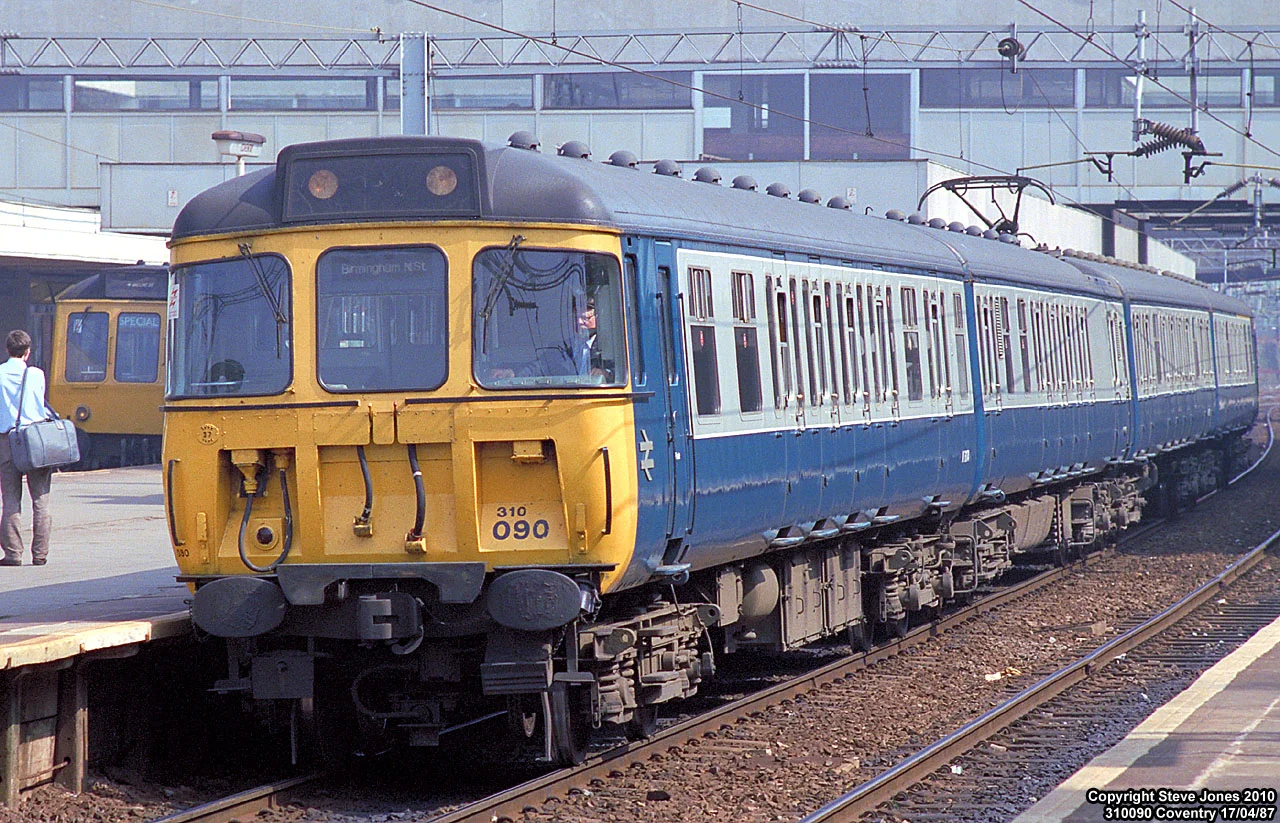
- Fuel Type Overhead Electric
- Usage Passenger
- Regions WCML, West Midlands, Midlands, LTS
Links


| Class | Videos |
|---|---|
| 310046 | 0 |
| 310047 | 0 |
| 310048 | 3 |
| 310049 | 1 |
| 310050 | 1 |
| 310051 | 1 |
| 310052 | 1 |
| 310053 | 0 |
| 310054 | 1 |
| 310055 | 1 |
| 310056 | 0 |
| 310057 | 0 |
| 310058 | 0 |
| 310059 | 0 |
| 310060 | 0 |
| 310061 | 1 |
| 310062 | 0 |
| 310063 | 0 |
| 310064 | 0 |
| 310065 | 0 |
| 310066 | 0 |
| 310067 | 1 |
| 310068 | 0 |
| 310069 | 1 |
| 310070 | 0 |
| 310071 | 0 |
| 310072 | 0 |
| 310073 | 0 |
| 310074 | 0 |
| 310075 | 2 |
| 310076 | 0 |
| 310077 | 2 |
| 310078 | 1 |
| 310079 | 0 |
| 310080 | 0 |
| 310081 | 0 |
| 310082 | 1 |
| 310083 | 0 |
| 310084 | 0 |
| 310085 | 0 |
| 310086 | 0 |
| 310087 | 1 |
| 310088 | 0 |
| 310089 | 0 |
| 310090 | 1 |
| 310091 | 2 |
| 310092 | 0 |
| 310093 | 1 |
| 310094 | 1 |
| 310095 | 0 |
| 310101 | 1 |
| 310102 | 1 |
| 310103 | 3 |
| 310104 | 0 |
| 310105 | 1 |
| 310106 | 0 |
| 310107 | 1 |
| 310108 | 0 |
| 310109 | 1 |
| 310110 | 2 |
| 310111 | 1 |
| 310112 | 0 |
| 310113 | 1 |
Learn about the Class 310
British Rail Class 310
The British Rail Class 310 was a class of 25 kV AC electric multiple unit (EMU) built for British Rail in the mid-1960s as part of the modernisation of suburban and outer-suburban electric services on the West Coast Main Line (WCML) and in the West Midlands. Before the introduction of TOPS, the class was known as the AM10. The units were constructed at Derby Carriage and Wagon Works between 1965 and 1967 and were among the most important early AC EMU types on the London Midland Region.
A total of 50 units was built. The class is historically significant for several reasons. It was one of the key EMU fleets introduced during the expansion of WCML electrification. It was also the first standard British Rail multiple-unit design to make substantial use of a Mark 2-style bodyshell concept, giving it a distinctive appearance compared with earlier suburban EMUs. In operational terms, the Class 310 became closely associated with services from London Euston to places such as Bletchley, Milton Keynes, Northampton and Birmingham New Street, as well as local and regional electric services in the West Midlands.
Although largely unglamorous and built for practical commuter work, the Class 310 had a long and varied career. It served British Rail through the blue and grey and sectorisation eras, later moved into privatised operation with c2c and Central Trains, and finally supplied vehicles for departmental testing use before complete withdrawal and scrapping.
Background and development
The Class 310 emerged during a period of large-scale investment in electric traction by British Rail. Electrification of the West Coast Main Line created the need for both main line electric locomotives and substantial fleets of EMUs for commuter and regional services. Earlier AC electric rolling stock classes had already entered service, but British Rail required additional units suitable for outer-suburban work with robust performance, adequate capacity and compatibility with 25 kV AC overhead equipment.
Under the pre-TOPS nomenclature, the type was classified as AM10, placing it in the same broad family as other AC EMU classes introduced in the 1950s and 1960s. The eventual TOPS designation Class 310 was applied later, in line with system-wide changes to classification and numbering.
The class was designed as a practical suburban and outer-suburban train rather than a high-speed express unit. Its maximum speed of 75 mph reflected the intended service pattern, which involved frequent stops and medium-distance commuter traffic rather than long-distance fast services. In this role, acceleration, braking performance and door operation were more important than top speed.
Design and technical features
Class 310 units were slam-door AC EMUs with steel-bodied vehicles and a semi-integral construction style influenced by the BR Mark 2 family. This gave them a more modern profile than some earlier suburban stock and made them visually distinctive among first-generation EMUs.
As built, the standard formation was a four-car unit, later classified as Class 310/0, consisting of driving trailers and a motor brake second open (MBSO) vehicle containing traction equipment and the pantograph. The original formations included both first and second class accommodation, which was still common on outer-suburban routes in this period.
The units used 25 kV AC overhead electrification, collecting current via a Stone Faiveley AMBR pantograph mounted on the motor coach. Traction equipment produced a total output suitable for stop-start suburban service, and the class operated with B4 bogies. The units were air-braked and fitted for multiple working with other compatible AC EMU types in the broader 302-312 family range.
The Class 310 introduced a number of technical features that were notable at the time. It is often described as the first standard BR multiple unit class to use disc brakes and naturally air-cooled rectifiers in normal service. These innovations reflected British Rail's move toward more modern electrical and braking systems during the 1960s.
Another feature remembered by passengers and enthusiasts was the glass partition behind the driver's cab, which allowed a view of the line ahead or behind from the end saloon. This became a well-liked characteristic of several BR-era EMU designs.
Subclasses and later configuration changes
All units were initially built as four-car sets, but later modifications created subclasses. The main subclasses were:
- Class 310/0: standard four-car units
- Class 310/1: units modified for later use, including formations reduced to three cars for certain Midlands services
In the later British Rail and privatisation periods, some sets were reformed and adapted for different traffic requirements. The changes included interior and equipment alterations and, in some cases, reconfiguration to better suit local service patterns. Enthusiast references sometimes note further subclass distinctions in practical use, but the principal operational split was between 310/0 and 310/1.
Entry into service and early operations
The Class 310 entered service in the mid-1960s, during the continuing electrification and modernisation of the London Midland Region. The units were introduced primarily on WCML suburban and outer-suburban services from London Euston, working routes through the southern and central sections of the electrified network.
Core route associations included services to:
- Bletchley
- Milton Keynes
- Northampton
- Birmingham New Street
- intermediate stations on the WCML suburban corridor
- local electrified services in the West Midlands
The class was well suited to these duties. It provided modern electric traction, relatively high capacity and a robust commuter layout at a time when British Rail was replacing older stock and consolidating electric operation on major routes.
Over time, the Class 310 became a routine part of everyday travel rather than a prestige fleet. This was typical of successful commuter stock. It performed a necessary role reliably enough to become familiar and, for many passengers, unremarkable.
British Rail era modifications and refurbishment
As with many long-lived BR EMU classes, the Class 310 underwent significant maintenance and refurbishment work during its career. A major programme in the mid-1980s, often described as a C1 refurbishment at Wolverton, modernised aspects of the fleet and altered the appearance of the units.
Changes included:
- new flat windscreens, replacing the earlier curved front glazing arrangement
- interior updates
- installation of a public address system
- modifications to gangway arrangements between vehicles
- other reliability and maintenance-related work
These changes produced the appearance most commonly associated with the class in its later years. Refurbished units looked visibly different from their early condition, and the flat-fronted style became familiar on WCML and West Midlands services.
The class also saw route-specific modifications. When units were transferred to more intensive stop-start routes, braking and other systems could be adjusted to meet local operational requirements.
Routes and regional use
Although most strongly associated with the London Midland Region, the Class 310 had a broader route history than is sometimes remembered.
West Coast Main Line and West Midlands
This was the class's core operating territory for most of its life. The fleet worked outer-suburban and regional services on electrified WCML routes and became a standard feature of electric operations around London Euston and Birmingham. The units were particularly associated with pre-privatisation commuter travel before newer classes such as the Class 317 and Class 321 began to displace them from some duties.
West Midlands local services
Class 310s also had a strong identity in the Birmingham area, where they worked local and regional electric services into and out of Birmingham New Street. In their later years, this became one of the most visible parts of the fleet's operation, especially for the reduced and modified units used by Central Trains after privatisation.
London, Tilbury and Southend line
In the late BR and privatisation eras, a significant group of Class 310 units moved to the LTS line (London, Tilbury and Southend route). In this role they operated under LTS Rail, later c2c, and became a temporary but important part of services on that network before replacement by newer stock, especially the Class 357.
This transfer illustrates the flexibility of BR-era AC EMUs. Although designed for WCML outer-suburban traffic, the Class 310 could be redeployed to another electrified commuter route when fleet cascades made it practical.
Relationship to other EMU classes
The Class 310 is often discussed alongside the Class 312, which had a similar body style and broad design lineage. The two classes were closely related but not identical. They had differences in traction gearing, equipment details and operational roles. In broad terms, the Class 310 was geared for lower-speed outer-suburban work, whereas the Class 312 was designed for higher-speed operation on routes such as the Great Eastern and Great Northern.
The class was also part of a wider family of AC slam-door EMUs that included Classes 302, 304, 305, 307, 308, 309, 311 and 312. Together, these units formed much of the backbone of British Rail's AC electric suburban and regional passenger service before later generations of sliding-door stock replaced them.
Privatisation and final passenger years
Following rail privatisation, Class 310 operations split between different operators depending on subclass and route.
- LTS Rail / c2c took over the former LTS-based Class 310/0 units.
- Central Trains operated the modified Class 310/1 units in the Midlands.
By this stage, the class was clearly life-expired in passenger terms when compared with newer stock. It remained useful, but accessibility standards, passenger expectations and maintenance economics increasingly favoured replacement.
On the c2c network, the Class 310s were progressively replaced by Class 357 Electrostar units between 1999 and 2002. In the Midlands, Central Trains' Class 310/1 units were withdrawn by 2002, with replacement duties covered by newer diesel and electric stock, including Class 170 and Class 323 units depending on route and service pattern.
The withdrawal of the Class 310 marked the end of nearly four decades of service. For a first-generation AC EMU class introduced in the 1960s, this represented a substantial operational life.
Departmental use and the Hitachi Verification Train
The Class 310's story did not end immediately with passenger withdrawal. In 2002, vehicles from two former Class 310/1 units, commonly cited as 310109 and 310113, were used to form a departmental test unit designated 960201.
This set became known as the Hitachi Verification Train or V Train. It was used to test and prove traction equipment in the UK and could be configured to operate on either:
- 25 kV AC overhead lines, or
- DC third-rail lines
The unit included Class 310 vehicles and adapted equipment to support dual-system testing. This made it a useful engineering and development tool in the period before Hitachi's later UK train programmes, including traction development relevant to future high-speed domestic train orders.
Departmental conversion of withdrawn EMUs was not unusual, but the Class 310's use in this role is notable because it connected a 1960s commuter unit design with much later rolling stock development work.
The V Train itself was eventually withdrawn and scrapped, bringing the final chapter of active Class 310-based operation to an end.
Passenger reputation and characteristics in service
In service, the Class 310 developed the reputation typical of many BR commuter EMUs. It was respected as practical, workmanlike stock, but not generally celebrated for comfort. By the standards of its era, it represented a substantial improvement over older suburban stock. By the standards of the 1990s and early 2000s, it increasingly felt dated.
Common characteristics remembered by passengers and enthusiasts include:
- a solid, traditional BR electric-unit ride
- slam-door operation and compartment-style design features in some vehicles
- distinctive driving-end view through the cab partition
- strong association with WCML commuter services and Birmingham-area electrics
- visibly altered appearance after refurbishment, especially flat-front windscreens
The class's maximum speed and gearing suited its role, but this also meant it was less flexible for higher-speed duties than some later EMUs. As newer stock arrived, the Class 310 became increasingly confined to routes where its limitations were manageable.
Accidents and incidents
Like many classes with a long service life on busy routes, the Class 310 was involved in a number of accidents and incidents, including collisions and derailments in the 1960s, 1970s and 1980s. Some incidents caused serious damage and led to reformations using vehicles from different units.
This was not unusual for a fleet operating intensively over several decades on congested passenger and mixed-traffic routes. The accident record forms part of the class's operational history, but it is not the defining feature of the class. More important historically is the fact that the fleet continued in service, was rebuilt and modified, and adapted to new routes and operators over a long period.
Preservation and survival
The Class 310 presents a difficult preservation story. Unlike some BR electric classes, no complete Class 310 unit is widely recognised as preserved. The class was fully withdrawn and, as far as mainstream preservation records indicate, the fleet was scrapped.
A major practical factor was the complexity and cost of preserving a full AC EMU from this period, including issues of storage space, transport, specialist components and materials management. The class also entered withdrawal during a period when preservation effort for first-generation EMUs was still less developed than it is today.
The departmental 960201 V Train, which reused Class 310 vehicles, survived longer than passenger units but was also eventually scrapped. As a result, the Class 310 is now represented mainly through photographs, film, records and enthusiast documentation rather than preserved rolling stock.
From a historical perspective, this absence is significant. The Class 310 was an important WCML electrification-era commuter train and an early example of BR's AC EMU standardisation. Its loss as a complete preserved unit leaves a gap in the physical preservation of British electric multiple unit history.
Legacy
The British Rail Class 310 was not a prestige train and was never intended to be one. It was a practical outer-suburban electric unit built to support the modernisation of passenger services on key electrified routes. In that role, it was successful.
Its historical importance lies in several areas:
- its role in the WCML electrification era
- its identity as an AM10 / early TOPS Class 310 AC EMU
- its Mark 2-influenced bodyshell design
- its long service on Euston suburban, West Midlands, and later LTS routes
- its afterlife in departmental form as the Hitachi Verification Train
Although no complete unit appears to survive in preservation, the class remains well remembered by passengers, railway staff and enthusiasts who knew it as a standard part of everyday electric railway operation in the Midlands and southern WCML area. In that sense, the Class 310 stands as a representative example of British Rail's durable, workmanlike commuter stock of the post-steam modernisation period.