- Add missing details (numbers, operators, headcodes) when they aren’t in the video
- Get recognised for contributions with points & badges
- Save favourites and come back to vehicles you’re tracking
All train classes · Electric traction
Class 90
Summary
- Vehicle entries 50
- Indexed videos 2988
- Stock type Locomotive
- Power source Overhead electric
- Most indexed vehicle 90049 (245 appearances)
- Builder Brush Traction
- Built 1986–1987
- Introduced 1987
- Wheel arrangement Bo-Bo
- Top speed 125 mph


| Locomotive number | Video appearances |
|---|---|
|
90001
Royal Scot
|
159 |
|
90002
Wolf Of Badenoch
|
187 |
| 90003 | 128 |
| 90004 | 153 |
| 90005 | 174 |
| 90006 | 196 |
| 90007 | 164 |
| 90008 | 151 |
| 90009 | 234 |
| 90010 | 171 |
| 90011 | 168 |
| 90012 | 147 |
| 90013 | 158 |
| 90014 | 175 |
| 90015 | 164 |
| 90016 | 197 |
| 90017 | 22 |
|
90018
The Pride Of Bellshill
|
243 |
|
90019
Multimodal
|
130 |
| 90020 | 110 |
| 90021 | 114 |
| 90022 | 8 |
| 90023 | 19 |
| 90024 | 111 |
| 90025 | 19 |
| 90026 | 83 |
| 90027 | 6 |
| 90028 | 93 |
| 90029 | 98 |
| 90030 | 21 |
| 90031 | 11 |
| 90032 | 7 |
| 90033 | 11 |
| 90034 | 95 |
| 90035 | 105 |
|
90036
Driver Jack Mills
|
107 |
|
90037
Spirit Of Dagenham
|
71 |
| 90038 | 8 |
| 90039 | 167 |
| 90040 | 141 |
| 90041 | 231 |
| 90042 | 176 |
| 90043 | 220 |
| 90044 | 238 |
| 90045 | 222 |
| 90046 | 174 |
| 90047 | 183 |
| 90048 | 222 |
|
90049
Skoda
|
245 |
| 90050 | 23 |
Learn about the Class 90
British Rail Class 90 — Britain’s late-BR mixed-traffic AC electric
The British Rail Class 90 is one of those railway types that looks quietly ordinary until you remember the moment it arrived. In the late 1980s British Rail was still building new locomotives, still betting on 25 kV overhead electrification, and still trying to standardise an electric fleet that had grown up in layers: early AC classes from the 1960s, the workhorse Class 86, and the faster Class 87 on the West Coast Main Line. The Class 90 was the attempt to take that lineage and produce a modern, reliable mixed-traffic electric that could do the fast passenger work and shift heavy freight, without needing a separate fleet for each task.
Fifty locomotives were built, numbered 90001–90050, assembled at Crewe Works in the period 1987–1990. They were designed for 25 kV AC operation and a top speed suitable for main-line passenger work (commonly quoted as 110 mph in service), while retaining the tractive effort and braking performance needed for container trains, automotive traffic, and other electrically-hauled freight. In short: a locomotive designed to earn its keep in the real railway, not just look good on a diagram.
The Class 90’s story is also a story of timing. It entered traffic just as British Rail was beginning to fracture into sectors and, soon after, privatisation-era companies. It then watched the passenger world move on—new EMUs, push-pull sets, and a general decline in "classic" locomotive-hauled inter-city work—while the freight world, in contrast, found fresh reasons to keep a fleet of AC electrics alive. That is why the Class 90 ended up with a career that is less about nostalgia and more about continued usefulness: it has been pulled in and out of front-line service, repainted, modified, stored, sold, returned, and still turns up on the sort of trains where an electric locomotive is the right tool for the job.
What follows is a factual, wiki-style description of the class: where it came from, how it is built, what it did under British Rail, what it did after, and why it has survived in a country that does not always make life easy for electric locomotives.
Origins and development: the Class 87/2 that became its own thing
To understand the Class 90 you have to start with what it was meant to be. The design began life as a development of the Class 87, sometimes described in the documentation and enthusiast literature as the Class 87/2 concept: an improved version of a proven high-speed AC locomotive for the West Coast Main Line. The motive was both practical and political. Practical, because the oldest first-generation AC types—Classes 81–85—were ageing and increasingly expensive to maintain. Political, because new-build procurement in the 1980s was never just engineering; it was also about industrial strategy, national capability, and how many different "solutions" you were willing to fund.
British Rail examined multiple options for its future electric traction. The Class 90 emerged as the chosen path: a modernised derivative rather than a clean-sheet redesign, built in sufficient numbers to replace older classes and to offer a standard, maintainable fleet. It was also competing, in the same era, with other "answers" to the high-speed problem: the Class 89 (a one-off prototype), and the new generation of fixed-formation, purpose-built high-speed sets that would define the East Coast (the Class 91 and Mk4 stock). In that context, the Class 90 is best seen as a conservative modernisation—familiar enough to be reliable, updated enough to justify ordering.
The result was a locomotive that, on paper, could do almost everything the 86 and 87 could do, but with improvements in electronics, traction control, and overall performance. British Rail’s intention was not glamorous: replace ageing assets, reduce failures, and create a class that could work across sectors.
Build and fleet: 50 locomotives, numbered 90001–90050
The class was built as a fleet of 50 locomotives, numbered consecutively:
- 90001–90050
They were assembled at British Rail Engineering Limited (BREL) Crewe Works, entering service between the late 1980s and the early 1990s. In the BR sector era, they were initially associated with the electrified main lines where mixed-traffic electrics were most valuable: the West Coast Main Line and the electrified routes radiating from it, plus work that required high-speed capability and Electric Train Heating for coaching stock.
As-built, the fleet was intended to be homogeneous: one class, one core technical standard. In reality, the Class 90’s later life introduced small differences—refurbishments, operator-specific equipment, and modifications that reflect the differing needs of passenger and freight users.
Technical description: what the Class 90 is mechanically and electrically
Power system and traction
The Class 90 is a 25 kV AC electric locomotive, collecting current from overhead catenary via a high-speed pantograph. It is a Bo-Bo design, meaning two bogies, each with two powered axles. That configuration gives a useful balance: enough adhesion for freight, good ride quality at speed, and route availability that suits most main-line electrified infrastructure.
Power output is often quoted as 5,000 hp continuous (with higher short-term peaks in some references), placing it in the same general bracket as the later builds of Class 87. The locomotive uses modern(ish) traction electronics for the era, with improved control compared with earlier first-generation AC electrics. Braking includes air braking and rheostatic braking, the latter particularly valuable for controlling speed on long descents while reducing brake block wear—useful for both freight and passenger service.
Speed and gearing
The class is commonly quoted with a maximum speed of around 110 mph in typical service configuration. That matters because it determines where the locomotive can sit in the timetable. A freight locomotive that tops out at 75 mph will struggle to fit between fast passenger services on a busy trunk route. A locomotive with 100+ mph capability can be slotted into passenger timings, haul relief services, and run at the head of charter trains without being an immediate obstacle.
Train supply: ETH and push-pull control
A defining feature for passenger work is the ability to supply Electric Train Heating (ETH)—effectively, power for coaching stock systems. The Class 90 is equipped for that, making it suitable for locomotive-hauled passenger rakes where the coaches rely on the locomotive for power supply.
The class is also associated with push-pull operation in certain passenger roles—particularly on East Anglia—using a Driving Van Trailer (DVT) and time-division multiplex (TDM) control arrangements. In practice this meant a Class 90 could work in a modern(ish) "fixed set" arrangement: locomotive at one end, DVT at the other, and no need to run the locomotive around at terminal stations.
Weight, route availability, and the practicalities
At around the mid-80-tonne range, the Class 90 sits where you expect for a main-line electric of its generation: heavy enough for adhesion and stability, but not so heavy that it becomes restricted to a narrow selection of routes. For a mixed-traffic locomotive, that is the whole point. It has to fit the network.
British Rail service: a mixed-traffic locomotive in a sectorised railway
When the Class 90 arrived, British Rail was already heavily sectorised. Passenger work was divided between InterCity and regional sectors, freight was broken into business units, and locomotive fleets were increasingly allocated based on who "owned" the cost. The Class 90 therefore entered a railway that was trying to treat locomotives as assets with clear roles, not general-purpose machines that could be borrowed on a whim.
Even so, the class did what it was built to do:
- Passenger work: hauling locomotive-hauled sets on electrified main lines, including fast services where a 100+ mph capability mattered, and relief/strengthening duties when stock or diagrams required it.
- Freight work: hauling electrically-worked container trains and other flows where the route was wired and the business case stacked up.
The operational sweet spot was always the same: wired routes with enough volume to justify electric traction and enough traffic density that reliable, powerful electrics earned their keep.
The East Anglia role: Class 90 + Mk3 + DVT
If you ask many people where the Class 90 became most recognisable in passenger service, the answer is East Anglia. The locomotive became closely associated with London Liverpool Street – Norwich and other Great Eastern Main Line duties in push-pull formation with Mk3 coaches and a DVT. The combination was, in its way, a practical masterpiece: comfortable coaches, a locomotive capable of brisk timings, and push-pull control that suited a busy, high-frequency inter-city pattern without time-consuming run-round moves.
In service terms, this was not a glamorous national flagship like the East Coast’s dedicated high-speed sets. It was a well-engineered solution that delivered inter-city performance using proven components. It also had longevity. Those sets, and the Class 90s that worked them, remained part of the East Anglia landscape for decades, surviving multiple franchise changes and repaint cycles.
Eventually, of course, the passenger world moved on. New electric multiple units were ordered for the route, offering better acceleration, more capacity options, and modern accessibility compliance in a single integrated train. The Class 90’s passenger role diminished accordingly, but the period left a clear legacy: the class proved it could do serious passenger mileage reliably, not merely turn up for charters.
West Coast and "classic" main line duties
The Class 90 also has West Coast roots, both in design intent and in early deployment. On the West Coast Main Line, it represented the continued evolution of BR’s AC traction. However, the West Coast passenger market changed rapidly in the late 1990s and early 2000s, particularly with the arrival of new fleets designed around fixed formations and high utilisation.
That shift did not remove the need for electric locomotives overnight, but it did reduce the number of core passenger diagrams that required them. Passenger locomotives, once the front-line stars of inter-city services, increasingly became:
- relief and cover traction,
- charter and special-train power,
- and occasional substitutes when the planned fleet was unavailable.
For a class designed as mixed-traffic, that was not a death sentence. It simply pushed the balance of work further toward freight.
Privatisation and the freight pivot: why electrics survived here
Post-privatisation, Britain’s freight railway became increasingly dominated by diesel traction, in part because so much of the freight network is not electrified, and in part because diesel locomotives offered flexible routing. But there has always been a counter-argument: where freight runs on electrified trunk routes, electric traction is efficient, powerful, and—when the infrastructure is available—operationally sensible.
That is where the Class 90 found its second long life. Freight operators, particularly those running container trains along electrified corridors, found the type useful because it sits between two extremes:
- it is more suitable for high-speed main line paths than slower freight locomotives,
- and it is robust enough to haul heavy trains without the delicacy sometimes associated with passenger-only traction.
In this context, the Class 90 became a workhorse of electrically-hauled intermodal freight. It also became the kind of asset that gets stored and reactivated depending on market cycles: when electric paths are plentiful and the fleet is healthy, it works; when economics or availability shift, it gets parked up rather than immediately scrapped.
Operators, ownership changes, and the modern era
In the modern era, Class 90s have principally been associated with two freight names:
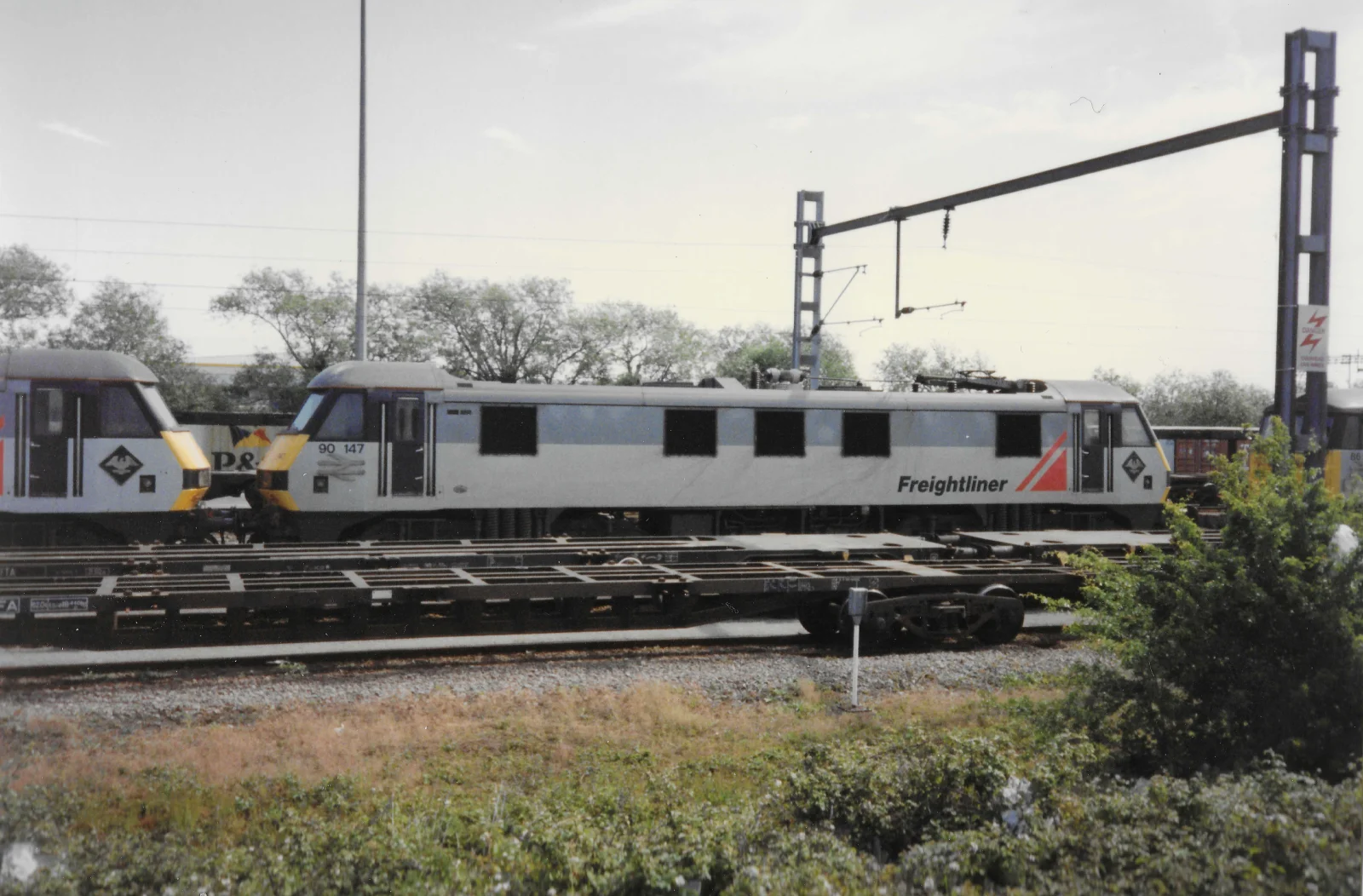
- Freightliner, the operator most strongly linked to electrically-hauled intermodal services.
- DB Cargo UK (the successor to EWS and DB Schenker), historically a major operator of the class but with shifting priorities and fleet strategies.
This is where the Class 90 story becomes very "today’s railway": locomotives move between operators, ownership changes hands, and fleets are trimmed or expanded not because the design is suddenly good or bad, but because the business case changes.
A notable recent development has been the reported transfer of some Class 90s from DB Cargo UK to Freightliner, reinforcing Freightliner’s position as the principal user of the type and reflecting DB Cargo’s decision to reduce or retire parts of its electric fleet. In practical terms, this means that the Class 90 is increasingly concentrated where it makes most sense: on intermodal flows that run under the wires for long distances.
It also means the class has entered the "small fleet management" stage of life. Once you are no longer a standard BR fleet with a full depot ecosystem, you become dependent on:
- parts availability,
- overhaul economics,
- and whether enough diagrams exist to justify keeping a locomotive in certification and in traffic.
This is why some Class 90s remain active while others sit stored, and why scrapping becomes a real outcome for members of the class even if the design itself remains useful.
Modifications and refurbishment: keeping a 1980s electric relevant
A locomotive built in the late 1980s will not remain unchanged if it is still working decades later. The Class 90 has seen modifications tied to:
- reliability improvements,
- operator-specific requirements (freight vs passenger),
- changes in safety systems and compliance,
- and the practical need to keep performance within traction power supply limits on a modern, heavily-loaded electrified network.
Some changes are obvious—livery, branding, minor cab and control updates. Others are technical and less visible: adjustments to electrical control systems, traction settings, and equipment replacements driven by obsolescence. As the network’s electrical loading becomes more complex—more EMUs, more regenerative braking, more high-power trains sharing the same supply sections—traction power modelling and current draw become operational issues rather than abstract engineering.
In modern main-line operation, it is not enough that a locomotive can draw power. It must draw power in a way that the supply can tolerate across the route and in combination with other traffic. That is one reason why discussions about Class 90s sometimes turn to current draw limits and the way the class behaves in multiple, or in specific electrified sections with tight capacity.
Incidents, withdrawals, and the fleet’s current shape
Over a fleet life measured in decades, withdrawals are inevitable. Some Class 90s have been withdrawn and scrapped, while others remain active, and others sit stored awaiting overhaul or a change in demand.
This mixed status is typical of a small, ageing locomotive fleet in Britain. The deciding factors are rarely romantic. They tend to be:
- whether a major overhaul is due,
- whether a transformer or traction component can be repaired economically,
- whether the operator has enough diagrams under the wires to justify a return to service,
- and whether leasing/ownership arrangements make sense.
The result is a fleet that, at any given time, is partly in service, partly stored, and partly gone. The Class 90 is therefore not a uniform "all working" class in the way it was in the early 1990s; it is a managed pool of assets, deployed where it pays.
Why the Class 90 matters: the last BR-built AC mixed-traffic electric in quantity
In British locomotive history, the Class 90 matters for a simple reason: it is one of the last sizeable batches of BR-era main-line electric locomotives built for mixed traffic. Later high-speed electric traction in Britain tends to be associated with fixed-formation trainsets rather than locomotive-hauled trains, while freight increasingly leaned diesel for flexibility. The Class 90 sits in the gap: a modern AC locomotive designed before those trends fully hardened.
It also matters because it demonstrates something that British railway policy often forgets: electric locomotives can be very effective where the geography supports them. When you have heavy freight flows on electrified trunk routes, the case for electric traction is not ideological; it is operational.
The class is therefore a useful case study in how rolling stock outlives the assumptions made when it was ordered. British Rail ordered the Class 90 to replace older electrics and standardise traction. Privatisation-era operators kept it because it remained capable and because electrified freight still needed powerful locomotives. In the 2020s, it continues in the same way: not as a museum piece, but as a working asset where the wires still run and the diagrams still add up.