- Add missing details (numbers, operators, headcodes) when they aren’t in the video
- Get recognised for contributions with points & badges
- Save favourites and come back to vehicles you’re tracking
Class 325
Summary
- Fleet entries 16
- Video appearances 461
- Most featured unit 325003 (46 appearances)
- Builder ABB York
- Built 1995–1996
- Introduced 1996
- Top speed 100 mph
- Fuel type Bi-mode
Links


Learn about the Class 325
British Rail Class 325: evolution, usage, and retirement (the “Dusty Bins”)
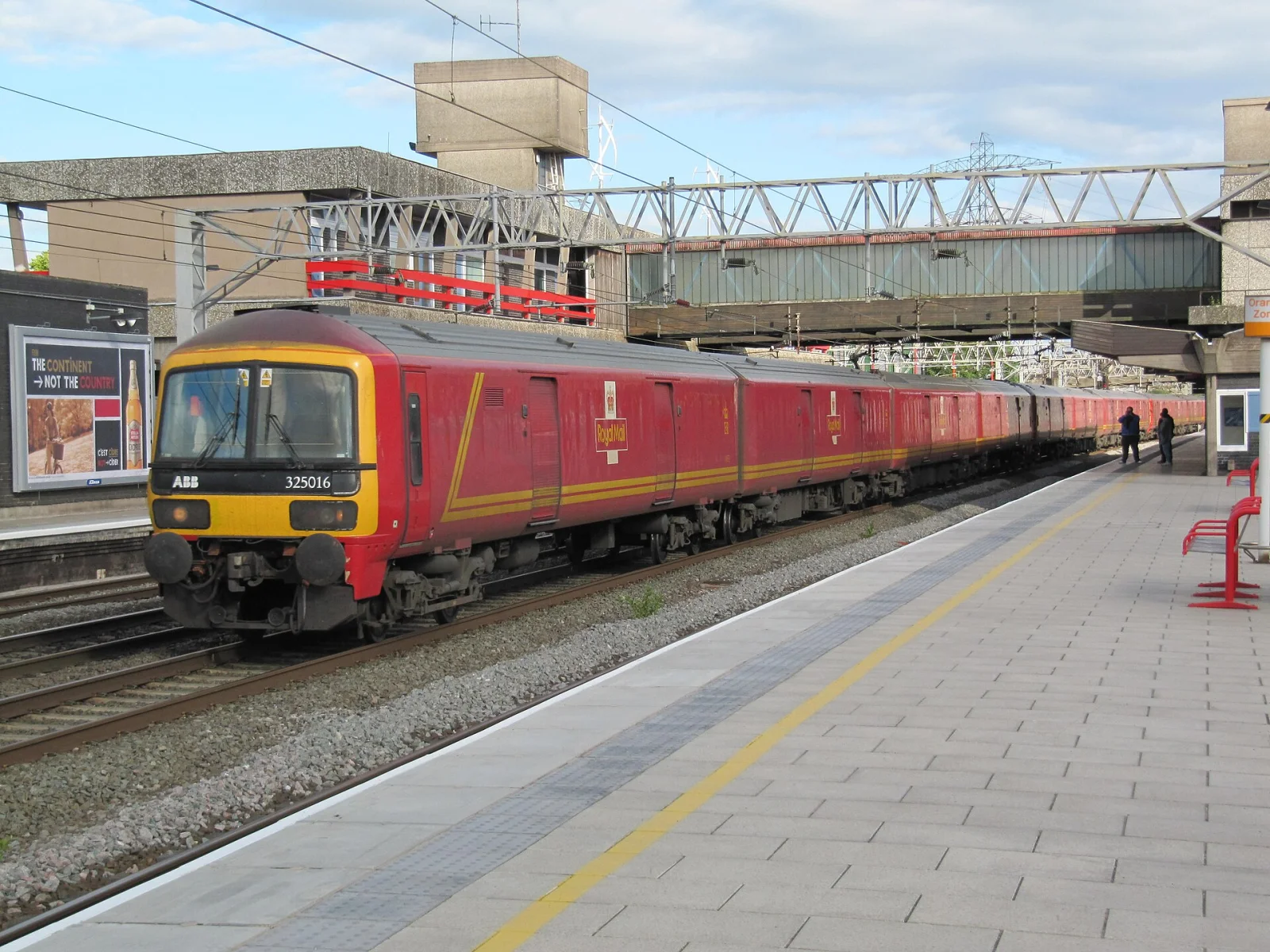
If you ever caught a windowless, slightly mysterious EMU blasting up the West Coast at passenger speeds, there’s a good chance it was a British Rail Class 325—Royal Mail’s purpose-built “bulk mail” train. They’re a bit of an oddity in UK rolling stock: a dedicated freight EMU, designed to run like a passenger unit (fast, frequent, multiple-working), but carrying nothing but containers of letters and parcels behind roller shutters.
Railways in Britain have hauled mail since the 19th century, and for decades the romance came from Travelling Post Office (TPO) services—people literally sorting letters on the move. But by the 1990s and early 2000s, the job changed: sorting moved off the train, and rail became a high-speed trunk link between big distribution centres. The Class 325 was built for exactly that world: pre-sorted mail, moved quickly and reliably between hubs. This is the story of how the Class 325 came to be, how it evolved operationally over nearly 30 years, what it actually did day-to-day, and why (and how) it finally bowed out.
1) Why a mail EMU existed at all
By the early 1990s, Royal Mail’s network was modernising. Instead of using central-London passenger termini as the “mail railway interface,” the idea was to funnel everything through dedicated hubs with rail access—most famously the Princess Royal Distribution Centre (PRDC) at Willesden, North London. Willesden offered something the old setup didn’t: room for modern logistics, good road connections, and direct links to the electrified main lines.
At the same time, the UK’s electrified network had grown in a patchwork way: 25 kV overhead on main lines like the WCML, and 750 V DC third rail in the south. Royal Mail wanted a fleet that could thread through both worlds without fuss. The result was a fleet of dedicated trains that could:
- sprint at up to 100 mph to fit into passenger timetables,
- load and unload quickly at terminals,
- and run on both major electrification systems.
Hence, the dual-voltage Class 325.
2) Design and build: a freight unit with passenger DNA
Built at Derby, with familiar engineering underneath
Sixteen units (numbered 325001–325016) were built by ABB Transportation at Derby in 1995–1996.
The Class 325 is often described as a “mail version” of existing passenger EMU technology. Under the skin, it shares a lot with the Class 319 family, using broadly similar traction and bodyshell engineering, but it wears a cab style closer to ABB’s Networker-era look.
Freight-first layout (and it looks like it)
Everything about the exterior screams “not for humans”:
- No passenger windows (because there are no passengers).
- Big roller-shutter/roller doors on the bodysides to load mail containers.
- No gangways between vehicles (it’s a sealed, purpose-built set rather than a walk-through passenger train).
Inside, the priority was moving standardised mail containers efficiently. The commonly quoted figure is a capacity of 235 “York” trolleys per unit.
4-car formation, built to run in multiple
Each unit is a 4-car set, and they can operate in multiple—commonly as 8-car or 12-car formations when demand spikes. That “passenger-style” multiple working is one of the defining ideas of the class: instead of shunting wagons, you just couple another set on and go.
Dual-voltage: overhead + third rail
Technically, they’re classic British dual-voltage kit:
- 25 kV AC via pantograph (main lines),
- 750 V DC via shoegear (third rail).
That capability mattered because the mail network wasn’t purely WCML/East Coast. Royal Mail needed flexibility to reach different terminals, and dual-voltage gave them options even if, in practice, the core work was often concentrated on the electrified trunk routes.
3) Early operations: fast mail on the main line
The “post-TPO” world
A useful timeline marker: the last Travelling Post Office services ran on the night of 9 January 2004, which effectively ended the era of sorting mail on moving trains in Britain. But that didn’t mean “no more mail by rail.” Instead, the model shifted to moving already-sorted mail between big hubs—basically turning trains into rolling conveyor belts between distribution centres.
The Class 325s entered service in that broader transition period, built for high-speed trunk transfers, particularly along the West Coast corridor.
Where they were based
They’ve long been associated with Crewe (maintenance) and operations tied into Willesden/PRDC as a key London node.
4) Operational evolution: who ran them, and how the work changed
One of the most interesting parts of the Class 325 story is that the trains stayed broadly the same, but the business environment around them changed constantly—privatisation, contract shifts, changing volumes, and changing ideas about what “good logistics” looks like.
a) Privatisation era and early contraction
At launch, operations sat in the orbit of British Rail’s parcels and mail activities, then moved through the post-privatisation freight landscape. Over time, Royal Mail’s appetite for dedicated rail services fluctuated, and there were periods of reduced work and storage as contracts and strategies changed.
b) The 2004 restart: Christmas brings rail back
After the TPO closure, Royal Mail did something that surprises people: it restored some mail movement by rail later in 2004, in time for Christmas demand. That revival used the Class 325 units on West Coast routes linking London (Willesden), Warrington, and Scotland.
This “rail returns for bulk transfer” moment is basically the Class 325’s second act: no more romance of onboard sorters—just pure logistics.
c) 2010: DB Schenker / DB Cargo era
By 2009/2010, the contract and management of the fleet moved to DB Schenker Rail, later DB Cargo UK. Under DB’s operation, the trains became a familiar sight on core flows—often described as a regular pattern of services between London, the Midlands/North West, and Scotland, with the ability to scale by coupling sets.
d) Keeping flexibility: Low Fell and “just in case” routes
Royal Mail kept rail access in places where it might be needed operationally—one example often mentioned is Low Fell (Tyneside). Services and diversions to Low Fell happened at various times, and it’s cited as a node Royal Mail could use when other modes (like air) were disrupted
5) What the Class 325 actually did (day-to-day)
The job: high-speed trunk haul for containers
In practical terms, a Class 325 working is closer to a commuter train diagram than a traditional freight path:
- it runs at passenger-ish speeds,
- uses passenger-like platforms/loops at terminals designed for it,
- and is scheduled to meet tight logistics cut-offs (mail doesn’t care about railway romance; it cares about tomorrow morning).
The “cargo” is containerised mail—trolleys and sealed units that can be rolled or transferred quickly at PRDC and other hubs.
Why EMU freight worked here
Freight EMUs make sense when:
- you want speed (100 mph paths),
- you want quick turnarounds (no loco run-rounds),
- and your loads are uniform and time-sensitive.
Mail is basically the perfect candidate—at least on paper.
Why it’s harder than it sounds
Running a bespoke fleet is expensive. You need specialist maintenance, spare parts, trained staff, and a steady flow of work that justifies having trains that only do one thing. Once volumes wobble, or road becomes more flexible, that business case starts to creak.
6) “Evolution” in the wider sense: the trains stayed, the world moved
The Class 325 didn’t have flashy mid-life rebuilds in the way some passenger fleets do. Its “evolution” is more about how it fit into a shifting logistics ecosystem:
a) From rail-as-core to rail-as-optional
Rail used to be central to long-distance trunk logistics for letters. Over time, Royal Mail leaned harder on road networks and air (and later, on “commercial rail services” rather than its own dedicated fleet).
b) From expansion dreams to reality checks
There were moments when rail freight advocates argued for more mail on rail—especially for environmental reasons. But the economics of a dedicated electric fleet, energy costs, and asset age all pushed the other way.
c) Ageing kit and the spare parts problem
By the 2020s, the fleet was approaching 30 years old. That’s not ancient for rolling stock, but it’s the danger zone for bespoke equipment—especially if suppliers have moved on and components become awkward to source. That reality fed directly into the retirement decision.
7) The end of the line: withdrawal and retirement
The 2024 decision
In July 2024, Royal Mail confirmed it would stop operating its own dedicated rail fleet, with the change taking effect on 10 October 2024. The stated logic was straightforward: cost and reliability, plus the fact the trains were “at the end of their operational lives,” alongside the difficulty of securing parts and the conclusion (after review) that other combinations of road, air, and commercial rail would work better.
DB Cargo UK, which operated the services, publicly criticised the move and warned it could push more traffic onto roads.
“Stop using rail” vs “stop using their own trains”
A subtle but important point: Royal Mail’s messaging around this period often distinguishes between:
- ending the operation of its own fleet and dedicated services, and
- still using commercial rail services in some capacity.
So it’s less “mail never goes by rail again” and more “Royal Mail won’t run these specific trains as its own dedicated operation.”
Withdrawal timing and last workings
Operational withdrawals happened in stages through 2024 (with some flows being pulled back before October). By late 2024, the Class 325’s regular role as Royal Mail’s front-line mail mover was effectively done.
8) Disposal, scrapping, and the “what happens next?” question
Scrapping and survival numbers
A significant portion of the fleet has been scrapped, with only a smaller group surviving into the mid-2020s according to fleet summaries and later reporting.
The Varamis angle: a potential second life
One of the most interesting post-Royal Mail developments is that Varamis Rail—a company focused on fast logistics by rail—has been reported as acquiring Class 325 units. Varamis has operated converted EMUs for parcels traffic, and industry reporting notes it also acquired the purpose-built Class 325 trains after Royal Mail’s withdrawal.
Now, to be clear: “acquired” doesn’t automatically mean “back in service tomorrow.” Bringing a niche fleet back into productive use depends on economics, maintenance capability, regulatory approvals, and whether the trains fit the operator’s lanes. But it does mean the Class 325 didn’t immediately vanish entirely into the scrapyard the moment Royal Mail stepped away.
9) Legacy: why enthusiasts remember them
A rare thing: freight that behaves like a passenger train
Britain has plenty of famous freight locomotives and wagons, but dedicated freight EMUs are rare. The 325s were also visually distinctive: sealed sides, shutter doors, and that almost “industrial appliance” vibe. It’s no surprise they picked up nicknames (including “Dusty Bins”).
A symbol of modern mail-by-rail
They represent a very specific phase of British logistics:
- after the heyday of TPO sorting,
- before the full dominance of road-first parcel networks,
- when the idea of a fast, electrified “mail shuttle” between hubs still felt like the future.
The retirement story is also a policy story
Their withdrawal isn’t just “old trains got old.” It’s about:
- energy and maintenance costs,
- network strategy,
- how much mail traffic is actually suited to rail in a world of next-day parcels,
- and how hard it is to justify bespoke assets when flexibility is king.
The Class 325 is a great example of a train designed for a very specific “logistics moment.” It solved a real problem brilliantly: move huge volumes of time-critical mail quickly on electrified main lines, with passenger-style flexibility and speed. But the very thing that made it special—being bespoke—also made it vulnerable when the economics shifted.
So its retirement feels a bit bittersweet. Not because it was glamorous (it absolutely wasn’t), but because it was purposeful: a machine built to do one job well, roaring through the night so a sack of letters could land in the right city before dawn.
And for a while, it did exactly that.