- Add missing details (numbers, operators, headcodes) when they aren’t in the video
- Get recognised for contributions with points & badges
- Save favourites and come back to vehicles you’re tracking
All train classes · Diesel traction
Class 60
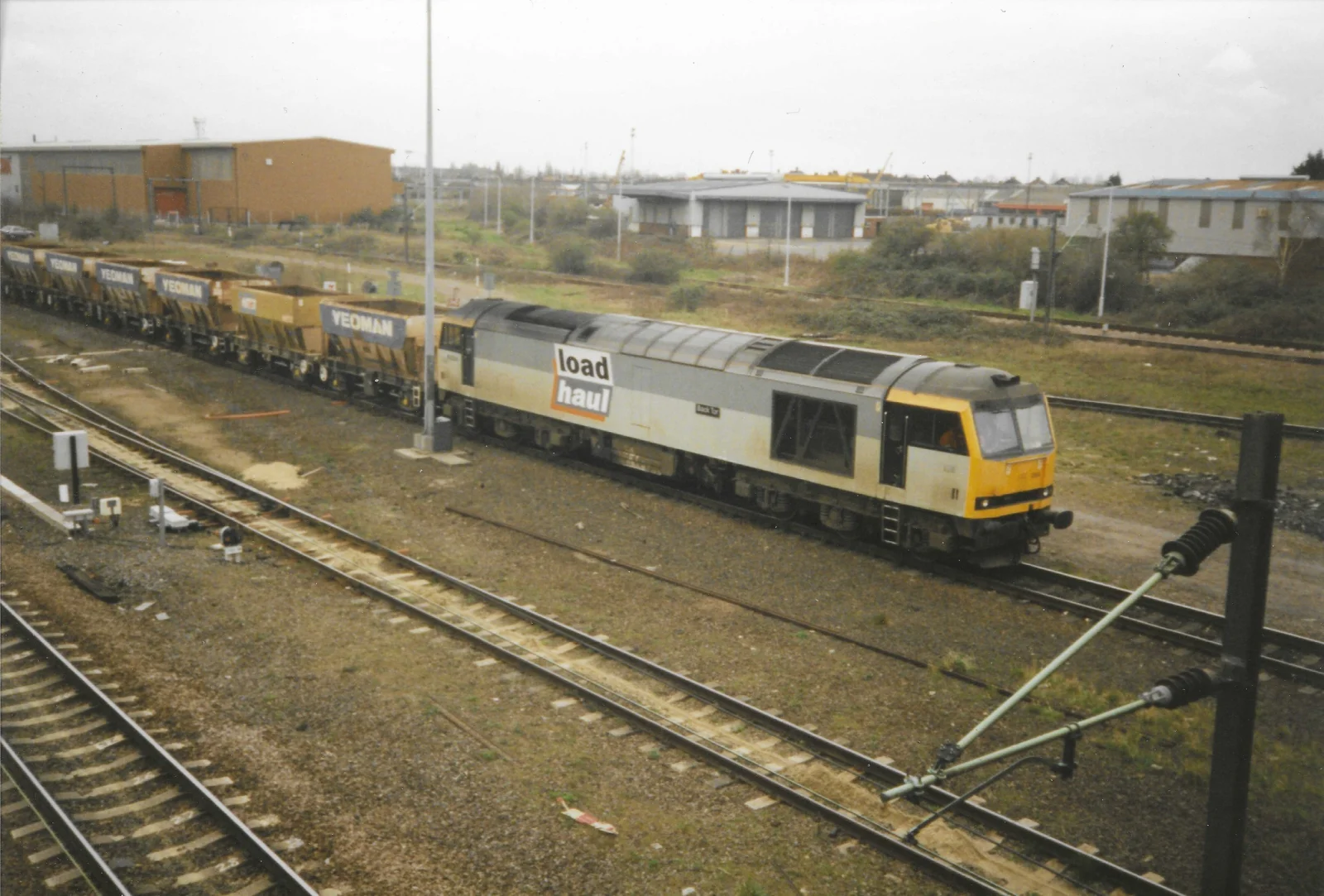
Summary
- Vehicle entries 100
- Indexed videos 5208
- Stock type Locomotive
- Power source Diesel
- Most indexed vehicle 60007 (543 appearances)
- Builder Brush Traction
- Built 1989–1993
- Introduced 1989
- Wheel arrangement Co-Co
- Top speed 60 mph
Links


| Locomotive number | Video appearances |
|---|---|
| 60001 | 134 |
| 60002 | 201 |
| 60003 | 83 |
| 60004 | 93 |
| 60005 | 108 |
| 60006 | 178 |
|
60007
Sir Nigel Gresley
|
543 |
| 60008 | 108 |
|
60009
Union Of South Africa
|
424 |
| 60010 | 138 |
| 60011 | 96 |
| 60012 | 53 |
| 60013 | 55 |
| 60014 | 67 |
| 60015 | 102 |
| 60017 | 143 |
| 60018 | 75 |
|
60019
Bittern
|
154 |
|
60020
The Willows
|
156 |
| 60021 | 139 |
| 60022 | 49 |
| 60023 | 32 |
|
60024
Clitheroe Castle
|
91 |
| 60025 | 35 |
| 60026 | 152 |
| 60027 | 32 |
| 60028 | 211 |
|
60029
Ben Nevis
|
171 |
| 60030 | 21 |
| 60031 | 44 |
| 60032 | 33 |
| 60033 | 51 |
| 60034 | 51 |
| 60035 | 43 |
| 60036 | 13 |
| 60037 | 33 |
| 60038 | 13 |
|
60039
Dove Holes
|
74 |
| 60040 | 114 |
| 60041 | 46 |
| 60042 | 26 |
| 60043 | 20 |
| 60044 | 61 |
| 60045 | 56 |
|
60046
William Wilberforce
|
200 |
| 60047 | 97 |
| 60048 | 47 |
| 60049 | 62 |
| 60050 | 30 |
| 60051 | 30 |
| 60052 | 26 |
| 60053 | 19 |
| 60054 | 87 |
|
60055
Thomas Barnardo
|
177 |
| 60056 | 82 |
| 60057 | 25 |
| 60058 | 15 |
|
60059
Swinden Dalesman
|
83 |
| 60060 | 52 |
| 60061 | 23 |
|
60062
Sonia
|
109 |
| 60063 | 101 |
| 60064 | 15 |
|
60065
Spirit Of Jaguar
|
76 |
| 60066 | 89 |
| 60067 | 49 |
| 60068 | 21 |
| 60069 | 115 |
| 60070 | 46 |
|
60071
Ribblehead Viaduct
|
54 |
| 60072 | 23 |
| 60073 | 9 |
|
60074
Teenage Spirit
|
116 |
| 60075 | 19 |
| 60076 | 114 |
| 60077 | 27 |
| 60078 | 18 |
| 60079 | 47 |
| 60080 | 23 |
| 60081 | 22 |
| 60082 | 23 |
| 60083 | 31 |
| 60084 | 22 |
| 60085 | 103 |
| 60086 | 25 |
| 60087 | 145 |
| 60088 | 72 |
| 60089 | 119 |
| 60090 | 22 |
| 60091 | 60 |
| 60092 | 88 |
| 60093 | 21 |
| 60094 | 23 |
|
60095
Whernside
|
174 |
| 60096 | 226 |
| 60097 | 40 |
| 60098 | 27 |
|
60099
Ben More Assynt
|
214 |
| 60100 | 85 |
| 60500 | 24 |
Learn about the Class 60
British Rail Class 60
The British Rail Class 60 is a class of heavy freight diesel-electric locomotive built for use on the British main line network. The class was designed in the late 1980s as British Rail's final new-build heavy freight locomotive type before privatisation, and it was intended to provide a modern, high-traction replacement for older freight classes on coal, metals, construction and petroleum traffic. A total of 100 locomotives were built by Brush Traction at Loughborough between 1989 and 1993, numbered 60001-60100. The Class 60 became known for its strong haulage capability and high tractive effort, particularly on very heavy trains where it could outperform more numerous but lighter-duty freight locomotives.
Although the class has had a mixed reputation in service, especially in relation to reliability and maintenance cost, it has remained an important part of UK freight operations. Significant numbers were stored for long periods, but a core fleet continued to work, and later overhaul programmes extended the useful life of selected locomotives. In the 2020s, the class remained active with operators including DB Cargo UK, DCRail (Cappagh) and GB Railfreight, while a small number entered preservation.
Background and procurement
By the mid-1980s, British Rail required a new generation of high-powered freight locomotive for heavy haul traffic. Existing classes such as the Class 56 and Class 58 had provided useful service, but BR sought a more capable and modern design that would improve haulage performance and fuel efficiency while reducing life-cycle cost. The success of the privately ordered Class 59 locomotives on stone traffic also raised expectations for performance and reliability in the heavy freight sector.
British Rail issued a competitive tender in August 1987 for a fleet of 100 locomotives. Several firms were invited to bid, but only three submitted proposals. These included Metro-Cammell, a GEC-led proposal linked to General Motors / Electro-Motive, and Brush Traction. Brush's bid was selected, and on 17 May 1988 the government announced an order valued at approximately £120 million for 100 locomotives. This decision was significant not only for the freight sector but also for domestic locomotive manufacturing, as the Class 60 would become the last main line diesel locomotive class ordered by British Rail.
Brush Traction acted as the principal contractor and final assembler at Loughborough, while subcontracting substantial component manufacture. This approach enabled rapid progress in production, and the first locomotive was formally handed over in 1989, less than 14 months after the order announcement. However, the route from construction to reliable traffic service was more difficult than the speed of assembly suggested.
Entry into service and early problems
The first locomotive, 60001, emerged in 1989, but the class did not enter routine revenue service immediately. A large number of faults were reportedly identified during testing and acceptance, requiring redesign and modification work. Problems affected areas such as software, suspension and structural details. British Rail and Brush worked through these issues, and the first Class 60s entered revenue-earning service in late 1990.
Once accepted, the locomotives were allocated across British Rail's freight sectors. The class was used primarily on coal, metals, construction and petroleum flows, and a number were also used on Channel Tunnel construction traffic before moving to other duties. The final locomotive was accepted into traffic in March 1993, completing the build of 100 machines.
The difficult introduction affected the class's long-term reputation. Enthusiasts and operators often described the Class 60 as a locomotive of considerable ability but uneven reliability. Even so, when working properly, the class was widely respected for its ability to start and haul very heavy trains in adverse conditions, which remained a key strength throughout its life.
Technical design
The Class 60 is a Co-Co diesel-electric locomotive, meaning it has six powered axles arranged on two three-axle bogies. This configuration supports high tractive effort and helps spread axle load for heavy freight duties. The locomotives were built with a maximum speed of 60 mph, which reflected their intended role on slow to medium-speed freight services rather than passenger or fast intermodal traffic.
One of the most distinctive aspects of the Class 60 is its heavy-duty design philosophy. The locomotives have a substantial structure and high adhesive weight, making them well suited to hauling loaded aggregate, steel and petroleum trains. The body design used a monocoque stressed-skin construction with diagonal trussing, differing from some earlier freight classes that used more conventional underframe arrangements.
Power is provided by a Mirrlees Blackstone 8MB275T diesel engine, an eight-cylinder four-stroke unit producing roughly 3,100 hp. The engine drives a main alternator, with power then supplied to six traction motors. The class used separately excited (SEPEX) traction control, a feature intended to improve adhesion and wheel-slip control by allowing individual axle response. In principle this gave the class strong low-speed control and better use of available traction, especially on difficult freight starts.
The Class 60's technical specification reflected late British Rail design priorities. The locomotives were intended to combine modern control systems with very high heavy-haul performance. In practice, the technical sophistication of some onboard systems contributed to maintenance complexity, especially when compared with later classes that prioritised modularity and standardisation across larger fleets.
Operations under British Rail
In British Rail service, the Class 60s were closely associated with the sectorised freight business. They appeared in Railfreight sector liveries and worked a wide range of heavy trains across England, Wales and Scotland. Their work included coal to power stations, petroleum traffic, steel trains, aggregate flows and other bulk freight.
The class arrived during a period of major change in the UK freight market. Traditional wagonload traffic was in decline, but heavy bulk flows remained strategically important. The Class 60 was designed for exactly these flows, and in many respects it was optimised for the final major phase of BR heavy freight operation before privatisation reshaped ownership, branding and traffic patterns.
The locomotives also became known for their names. In BR days, Class 60s were named in a traditional style, with many carrying the names of mountains or notable scientists and engineers. This naming policy gave the class a distinctive identity and made individual locomotives easy to recognise. Some names were later changed by post-privatisation operators, but the original naming tradition remained a notable part of the class's image.
Privatisation and EWS era
Following the privatisation of British Rail, all 100 Class 60s passed to English, Welsh & Scottish Railway (EWS). This gave EWS a powerful heavy freight fleet, but the class's future was never entirely secure. EWS inherited several locomotive classes and made strategic choices about which fleets to prioritise. Over time, the more numerous Class 66 became the backbone of freight traction due to its standardisation, relative simplicity and lower operating cost in many duties.
The Class 60 remained valuable for specialist heavy-haul work, but its availability and maintenance burden led to periods of underuse. During the early 2000s, substantial portions of the fleet were placed into storage as traffic patterns changed and EWS rationalised its locomotive fleet. Some locomotives were retained as parts donors, and others remained technically extant but inactive for long periods.
Despite this, the Class 60 did not disappear. The class had a proven ability on trains where high tractive effort mattered more than speed, and this preserved its niche. In operational terms, the Class 60 became a specialist heavy freight locomotive rather than a general-purpose freight machine.
DB Schenker and the "Super 60" overhaul programme
When EWS was acquired by DB Schenker (later DB Cargo UK), the Class 60 fleet entered a new phase. During the late 2000s and early 2010s, there were periods when the class's long-term future looked uncertain. Some locomotives were offered for disposal, and many remained stored. At the same time, the locomotives' heavy-haul capability meant there was still a business case for retaining selected examples.
DB Schenker therefore launched a programme to overhaul part of the fleet. Announcements in 2010 and 2011 set out plans for a batch of locomotives to receive major engineering work. This later became widely known as the "Super 60" programme. The work included comprehensive engine overhaul and refurbishment of major components such as traction motors, bogies, control systems, cabs and electrical equipment.
The aim was not to create a completely new locomotive, but to restore and improve a selected subfleet for extended service life. This was a practical response to market needs. For very heavy trains, a well-maintained Class 60 could still offer performance advantages, and refurbishment was more economical than buying a small fleet of entirely new heavy-haul locomotives for specialist work.
The overhaul programme helped stabilise the class's operational future. It also reinforced the distinction between active and inactive locomotives, with a smaller number receiving investment while others remained stored pending possible sale, parts use or eventual disposal.
Later operators and continuing use
In addition to DB Cargo UK, Class 60s later operated with DCRail and GB Railfreight (GBRf). The locomotives found continued use on infrastructure and heavy freight flows, including aggregates, biomass and construction-related traffic. Their ability to handle heavy loads remained the key reason for retention.
GB Railfreight acquired a group of Class 60s and used them on duties that benefited from their high tractive effort. DB Cargo UK also undertook maintenance support for GBRf's Class 60 fleet under a contract announced in 2020, illustrating how the class remained relevant enough for specialist engineering support arrangements between operators.
DCRail, associated with the Cappagh group, also returned several former stored locomotives to service. This helped demonstrate that, with overhaul and careful maintenance, some long-stored Class 60s could still be returned to operational use. In this phase, the class became more fragmented across operators, but it also gained something of a second life beyond the expectations that existed when many examples were first stored.
Liveries, names and identity
The Class 60 has carried a wide range of liveries across its service life. Early locomotives appeared in Railfreight sector colours aligned with coal, construction, metals and petroleum sectors. Under EWS, many were repainted into the company's red and yellow scheme, while others briefly retained BR liveries with EWS markings.
Later, examples appeared in DB Schenker / DB Cargo red, Colas colours on leased machines, DCRail/Cappagh branding, and GBRf liveries. A number of locomotives also carried special liveries and revised names for publicity, commercial partnerships or commemorative purposes. This gave the class a varied visual history that reflects broader changes in the UK freight railway industry from sectorisation through privatisation and into the modern multi-operator era.
The naming tradition has also remained important to enthusiasts. Many Class 60s retained or later regained names, and some operators restored original names as part of relaunches. This has helped sustain public and enthusiast interest in the class, especially as active numbers declined.
Performance and reputation
The Class 60's reputation is best understood as a combination of strengths and weaknesses. On the positive side, the locomotives are widely respected for heavy-haul capability, tractive effort and their ability to handle difficult freight duties. They were purpose-built for the kind of work that defined the heaviest end of British bulk rail freight.
On the negative side, the class gained a reputation for complexity and inconsistent reliability, particularly in its early life and during periods when maintenance investment was constrained. As newer and more standardised classes became dominant, the Class 60 could appear expensive to maintain in relation to fleet size and utilisation.
This combination explains the class's unusual career pattern. It was never a complete failure, because its core performance strengths were real and commercially useful. It was also never a universal freight solution after privatisation, because its maintenance and availability challenges limited widespread deployment. Instead, it settled into a specialist role that suited its design strengths.
Preservation and heritage interest
Preservation interest in the Class 60 developed as more locomotives were stored and the risk of attrition increased. Unlike older and simpler classes, preserving a Class 60 presents significant practical challenges, including purchase cost, transport, secure storage, heavy maintenance requirements and the complexity of keeping a modern main line freight locomotive in working order.
Even so, preservation efforts have emerged. A small number of locomotives have entered preservation, including examples such as 60086, 60050 and 60081, with different statuses ranging from static display to overhaul and restoration projects. This is important because the Class 60 represents a major chapter in late British Rail diesel locomotive development and the final BR-era heavy freight locomotive programme.
The Class 60 Preservation Group has publicly stated that it aims to preserve and operate a working example of the class, with a long-term ambition to restore a locomotive to operational condition for heritage and potentially charter use. The group has also highlighted the challenge of funding, volunteer support and compatibility issues such as braking arrangements for heritage railway stock. This reflects a broader reality across modern traction preservation, where engineering scale and cost can be much greater than for smaller locomotives.
Preservation of the class matters historically. The Class 60 sits at the intersection of several railway stories, including the end of BR locomotive procurement, the transition to privatised freight operation, and the evolution of heavy bulk rail traffic in Britain after the decline of coal. A preserved example can therefore represent not only a locomotive design, but also an entire period of industrial and transport history.
Future prospects and ongoing relevance
Although many Class 60s remain stored, the class continues to attract attention because it still offers useful capability in niche heavy freight roles. Operators have shown that selected locomotives can be overhauled and returned to traffic where there is a clear business need. This has kept the type in the public eye long after many assumed it would disappear from active service.
The class has also appeared in discussions about future propulsion technologies. In 2024, a project involving Steamology, Arup and Eversholt Rail, with Freightliner collaboration, was announced to explore conversion of a Class 60 using hydrogen-fuelled advanced steam technology as a zero-emission concept. Whether or not such projects lead to wider implementation, they show that the Class 60 remains a useful platform for experimentation because of its size, power and structural robustness.
In historical terms, the Class 60 is an important but often underappreciated locomotive class. It was built in relatively large numbers, designed for a specific and demanding freight role, and has survived into the modern era in both operational and preservation contexts. Its career has been shaped by changing freight markets, operator strategies and maintenance economics more than by any single technical factor.
Legacy
The British Rail Class 60 can be seen as the final expression of a particular British heavy freight locomotive tradition. It was commissioned by British Rail, built in Britain, and designed around the requirements of domestic bulk freight at a moment just before the railway industry's organisational structure changed fundamentally. That alone gives it historical significance.
At the same time, the Class 60 is not merely a historical footnote. It remains a class with a continuing operational and preservation story. Active examples still demonstrate the value of high-tractive-effort diesel locomotives on specialist duties, while preserved examples and preservation groups are beginning the slower work of ensuring the type is represented for future generations.
For these reasons, the Class 60 occupies a distinctive place in modern British railway history. It is a locomotive class defined by strength, specialisation and survival. Its career has been uneven, but it has also been far longer and more adaptable than many expected.