- Add missing details (numbers, operators, headcodes) when they aren’t in the video
- Get recognised for contributions with points & badges
- Save favourites and come back to vehicles you’re tracking
All train classes · Diesel traction
Class 47
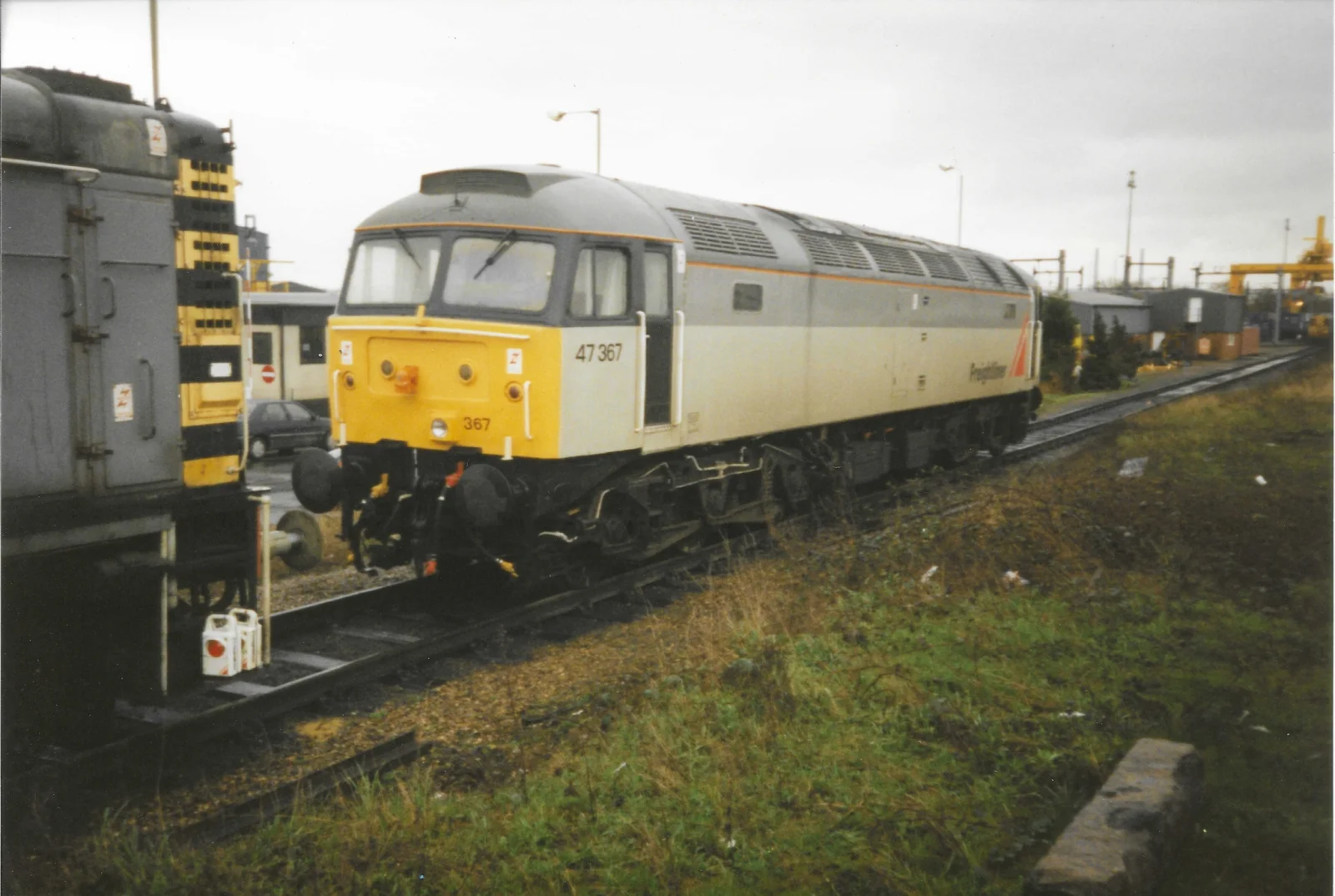
Summary
- Vehicle entries 100
- Indexed videos 6490
- Stock type Locomotive
- Power source Diesel
- Most indexed vehicle 47593 (557 appearances)
- Builder Brush Traction / Crewe Works
- Built 1962–1968
- Introduced 1962
- Wheel arrangement Co-Co
- Top speed 95 mph


| Locomotive number | Video appearances |
|---|---|
| 47004 | 28 |
|
47077
North Star
|
16 |
| 47105 | 43 |
| 47114 | 5 |
|
47117
Sparrowhawk
|
4 |
| 47128 47811 | 2 |
| 47129 47813 | 4 |
| 47164 57305 | 2 |
| 47192 | 10 |
| 47194 | 6 |
| 47205 | 9 |
| 47206 | 9 |
| 47237 | 135 |
|
47245
V. E Day
|
174 |
|
47270
Swift
|
49 |
| 47292 | 36 |
| 47298 | 35 |
|
47306
The Sapper
|
34 |
| 47355 | 22 |
| 47367 | 18 |
| 47368 | 1 |
| 47376 | 93 |
|
47401
North Eastern
|
31 |
| 47402 | 14 |
| 47417 | 4 |
| 47449 | 19 |
|
47484
Isambard Kingdom BRunel
|
14 |
| 47488 | 11 |
| 47492 | 4 |
| 47501 | 202 |
| 47503 47771 | 15 |
| 47526 | 18 |
| 47571 57305 | 1 |
| 47579 | 33 |
|
47580
County Of Essex
|
224 |
|
47593
Galloway Princess
|
557 |
| 47596 | 28 |
| 47635 | 32 |
| 47640 | 10 |
| 47643 | 40 |
| 47656 47811 | 3 |
| 47658 47813 | 2 |
| 47701 | 57 |
| 47703 | 38 |
|
47712
Lady Diana Spencer
|
379 |
| 47714 | 61 |
|
47715
Rail Engineering Solutions / Quality Assured
|
117 |
|
47727
Edinburgh Castle
|
213 |
| 47739 | 265 |
| 47744 | 20 |
|
47746
Chris Fudge 29.7.70-22.6.10
|
292 |
|
47749
City Of Truro
|
220 |
| 47760 | 181 |
| 47761 | 10 |
| 47765 | 42 |
| 47768 | 16 |
| 47769 | 22 |
| 47771 | 5 |
|
47772
Carnforth T.m.d
|
68 |
| 47773 | 358 |
| 47776 | 6 |
| 47785 | 4 |
| 47786 | 83 |
| 47787 | 15 |
| 47798 | 42 |
| 47799 | 23 |
| 47802 | 404 |
| 47804 | 238 |
|
47805
Roger Hosking Ma 1925-2013
|
505 |
| 47810 | 444 |
| 47811 | 17 |
| 47812 | 452 |
|
47813
Jack Frost
|
337 |
|
47815
Great Western
|
261 |
| 47816 | 40 |
| 47818 | 122 |
| 47822 57305 | 13 |
| 47826 | 225 |
| 47828 | 257 |
| 47830 | 108 |
| 47832 | 251 |
| 47841 | 76 |
| 47843 | 62 |
| 47847 | 31 |
| 47848 | 200 |
| 47851 | 83 |
| 47853 | 156 |
| 47854 | 112 |
| 47888 | 0 |
| D1100 47298 | 2 |
| D1500 47401 | 8 |
| D1501 47402 | 27 |
| D1516 47417 | 4 |
| D1702 47114 | 0 |
| D1713 47488 | 0 |
| D1719 47811 | 0 |
| D1720 47813 | 0 |
| D1758 57305 | 1 |
|
D1935
Roger Hosking Ma 1925 - 2013
47805
|
353 |
| D1946 47503 | 0 |
Learn about the Class 47
British Rail Class 47 (Brush Type 4)
The British Rail Class 47 is the locomotive that, for a generation, seemed to be everywhere at once. Built in the 1960s in large numbers and designed for mixed-traffic work, it became the go-to diesel for an era when British Rail needed one dependable, reasonably powerful machine to replace steam across express passenger, parcels and freight. If the Class 55 "Deltic" was a specialist sprinter and the big freight types later became dedicated hauliers, the Class 47 sat squarely in the middle: not exotic, not delicate, and rarely out of place.
It is a diesel-electric Co-Co locomotive—six powered axles, two three-axle bogies—built as Brush Type 4. In practice it was the "standard big diesel" of its day. It hauled named trains and unglamorous stop-gaps; it rescued failed units; it worked summer Saturdays to the coast and winter freights in the dark; it spent years in depots and yards and then reappeared, refurbished, on passenger turns again. Even in withdrawal, it kept finding ways to remain useful: charter operators, departmental work, and rebuild programmes ensured the class stayed part of the railway conversation long after newer traction arrived.
What follows is a factual outline of what the Class 47 is, how it came to dominate the main line, how it changed as the network changed, and why it endured. If you are comparing Britain's big mixed-traffic diesels, the wider stock index also covers classes such as the Class 37 and Class 50.
Origins: one locomotive to do (almost) everything
The Class 47 belongs to the crucial transition period of British traction: the 1960s drive to replace steam quickly with a manageable number of diesel types. British Rail’s Modernisation Plan had promised a cleaner, faster, more reliable railway, but early diesel programmes produced a mixed bag—some excellent, some troublesome, many overly diverse.
The Brush Type 4 emerged as a corrective: a powerful mixed-traffic diesel, built in large volume, that could take on principal passenger and freight duties across regions. It arrived at a moment when steam was being removed at pace and the railway needed numbers as much as it needed innovation. A design that could be built quickly, deployed widely, and maintained with reasonable predictability was worth its weight in revenue protection.
Between 1962 and 1968, 512 locomotives were built, making the class the most numerous British main-line diesel type. Construction was shared between Brush Traction’s Falcon Works at Loughborough and British Rail’s Crewe Works, reflecting both the scale of the order and the urgency of dieselisation. The fleet first carried "D" numbers (notably D1500–D1999, plus an additional batch numbered D1100–D1111) before later TOPS renumbering into the 47xxx series.
Technical design: conservative, capable, and built for availability
Layout and wheel arrangement
The Class 47 is a Co-Co locomotive: six powered axles, chosen to spread weight and provide good adhesion for both passenger and freight. This gave it route capability across much of the network, while providing enough grip to handle heavier trains than smaller four-axle types could manage reliably.
Diesel-electric transmission
As with most large British diesels of the period, the Class 47 uses diesel-electric transmission. A diesel engine drives a generator/alternator, producing electricity for traction motors. The practical advantage is controllable power at low speed and sustained output at higher speed, with fewer mechanical transmission complications.
Prime mover: Sulzer 12LDA28-C
The defining mechanical feature is the Sulzer 12LDA28-C engine: a twin-bank twelve-cylinder unit that, on paper, gave the class the output required for principal turns. The fleet’s story, however, is a reminder that headline power figures do not automatically translate into fleet reliability. Early in the class’s life, British Rail made a key operational decision: the locomotives were de-rated from about 2,750 bhp to around 2,580 bhp to reduce stress and improve reliability, with little noticeable loss in everyday performance. It was a pragmatic trade: slightly less power, markedly better availability.
Speed and role
Class 47s were built with different gearing and equipment depending on intended duty, resulting in various maximum speeds. Many were associated with 95 mph capability for passenger work, while some freight-focused members were geared for lower maximum speeds, and later specialised conversions reached 100 mph in certain subgroups. The essential point is that the class was designed to be flexible: fast enough for express passenger, strong enough for freight, and adaptable enough to keep both camps satisfied.
Heating and train supply: why subclasses mattered
For much of the 1960s and 1970s, passenger stock heating was not a minor detail. It determined whether a locomotive could work a particular service. Early diesel passenger fleets often relied on steam heating (generated by a boiler on the locomotive) for coaching stock designed in the steam era. Later, as coaching stock increasingly required electric train heating (ETH), locomotives either needed ETH fitted or had to be confined to services still using steam heat.
This is where the Class 47’s internal variety becomes important.
- Class 47/0: generally associated with locomotives fitted with steam heating boilers.
- Class 47/3: locomotives with no train heating equipment, often directed toward freight and non-heated duties.
- Class 47/4: locomotives fitted with ETH, making them suitable for electrically heated passenger stock.
The fleet did not remain static. As passenger heating standards shifted, many locomotives were modified—boilers removed, ETH fitted, wiring altered, and control systems updated. The class’s capacity to be reconfigured rather than discarded is a recurring theme: it stayed useful because it could be changed to match what the railway required.
Early service: rapid deployment across regions
Once deliveries began, Class 47s spread quickly. They were intended as a nationwide workhorse and were allocated accordingly. The locomotives turned up on express passenger work, parcels trains, fast freights, and secondary services wherever a Type 4 diesel was needed.
The fleet’s strength was not that it was perfect from day one—early reliability issues and the later de-rating decision make that clear—but that it was good enough to standardise around. In the operating culture of the time, a locomotive that could be made reliable through sensible modifications was far preferable to a smaller class of specialist machines that required unique parts and unique knowledge.
In the late 1960s and into the 1970s, Class 47s became one of the main tools used to finish the job of steam replacement on many routes. They hauled expresses on main lines, worked cross-country passenger trains, and took on freight where their power and route availability suited. For many railway staff and passengers, the 47 became the "default" main-line diesel.
Mixed-traffic reality: passenger, parcels, freight, rescue
The term "mixed-traffic" can sound vague. For the Class 47, it was literal.
Passenger work
Class 47s hauled long-distance trains on multiple regions, often on routes where electrification was incomplete or absent. They worked prestigious diagrams and ordinary inter-regional services alike. Their suitability for passenger work depended heavily on heating equipment: in the steam-heat era, a boiler-fitted 47 was valuable; in the ETH era, an ETH-fitted 47 became the more versatile tool.
Parcels and mail
For years, parcels and postal trains were a significant part of railway operations, requiring locomotives that could run fast, stop where needed, and keep time overnight. The Class 47 was a natural fit: enough power for quick schedules, robust enough for regular nightly work.
Freight and engineers’ trains
While later decades saw freight traction become more specialised, Class 47s spent substantial time on freight. Freight-only variants and heating-removed machines were common sights on flows that demanded a capable Type 4 but did not require the newer, heavier dedicated freight types.
Rescue and standby
A practical measure of a locomotive’s success is how often it is used to fix other people’s problems. Class 47s became well known as rescue engines: called upon to haul failed trains out of trouble, cover shortages, or step in when more modern traction was unavailable. Their broad compatibility and widespread driver knowledge made them the obvious "spare key" in the drawer.
Names, liveries, and public recognition (without the romance)
Many Class 47s carried names at various points, reflecting British Rail’s naming culture and later operator branding. Liveries changed repeatedly: from early BR schemes through the corporate blue era, then into sectorisation colours, and later the varied palettes of the privatised railway.
This matters in a factual history because it signals how widely the class was used. A locomotive type that survives multiple branding regimes is usually doing so because it remains commercially useful. The Class 47 did not merely survive; it stayed in active work while the railway around it was reorganised.
Sectorisation and the 1980s: a class that adapted
The 1980s saw British Rail reorganise into sectors—InterCity, Regional Railways, and various freight sectors—each with its own priorities. The Class 47 was pulled in different directions:
- Passenger-focused ETH locomotives were valuable to sectors running locomotive-hauled coaching stock.
- Freight and non-heated machines found work in parcels, engineers’ duties, and freight flows.
- Some locomotives were modified for particular tasks, creating a patchwork of equipment differences across the fleet.
By this point, the class’s reputation had matured. It was not the newest diesel on the block, but it was familiar, widely supported, and still capable. As long as it could meet the operational requirement—speed, heating, braking compatibility—it could earn its keep.
Subclasses and special roles: the class fragments, but the concept holds
Over time, the Class 47 gained additional subclasses beyond the headline 47/0, 47/3, and 47/4. These generally reflected specific modifications or operational niches—differences in gearing, control systems, train supply, or special equipment. The exact subclass history can be complex because locomotives moved between categories as they were rebuilt or re-equipped.
What matters for a class overview is the reason why this happened: the 47 was a platform that could be re-tasked. Instead of being withdrawn when a particular feature became obsolete (steam heat, for instance), locomotives could be stripped, rewired, and reassigned. In practical railway management, this is how a fleet extends its life: not by staying the same, but by changing in controlled ways.
Privatisation: the long tail of usefulness
After privatisation, Class 47s passed to a variety of new operators. Many were withdrawn as newer locomotives and multiple units took over passenger diagrams. Others found a second life:
- Charter and heritage operations valued the class’s ability to haul conventional coaching stock.
- Freight operators used remaining machines where their capabilities fit the job, particularly where newer traction was not essential.
- Departmental and infrastructure work provided further employment for locomotives no longer required for regular passenger timetables.
A significant chapter in the post-BR story is the rebuild programme that created Class 57 locomotives from Class 47s. This underlines the robustness of the basic platform: rather than scrap, the industry chose to rebuild a substantial number into a newer specification for modern operational needs.
Even among those not rebuilt, a notable number survived in service far beyond what would have seemed likely in 1968. That is not accidental. It reflects a locomotive that was maintainable, understood, and flexible—exactly the traits that keep traction alive in a cost-conscious industry.
Reliability and reputation: the "Duff" and the working reality
The Class 47 acquired nicknames—most famously "Duff"—and the folklore around those names often drifts into exaggeration. The factual position is more nuanced.
- The class had early issues that required attention and led to the de-rating decision.
- Once matured, large parts of the fleet provided dependable service for years.
- The very size of the class meant that failures were highly visible: if you have hundreds of locomotives in traffic, you will see more failures in absolute terms than you will with a small class, even if the failure rate is acceptable.
The real measure is its endurance. A locomotive that is truly unreliable is not kept at the centre of passenger and freight operations for decades, nor is it chosen as a basis for rebuild programmes. The Class 47’s record is that it was good enough to standardise around, and adaptable enough to keep relevant.
Withdrawal and survival: why so many remain known today
Withdrawal of the Class 47 was gradual, uneven, and shaped by what replaced locomotive-hauled services. As multiple units took over passenger work and dedicated modern freight fleets expanded, the 47’s role shrank. But it never vanished in one clean sweep.
Reasons some survived include:
- continued demand for locomotive-hauled charter services,
- niche freight and departmental roles,
- the availability of parts and long-standing maintenance knowledge,
- and, crucially, the fact that a Class 47 can still do a great deal of useful work if the job does not demand the latest standards.
A portion of the fleet is preserved, and a smaller portion remains operational in various capacities. The class has become part of Britain’s railway landscape in a way that purely short-lived fleets never do: not because it was the fastest or most advanced, but because it was numerous, versatile, and persistent.
Why the Class 47 matters, in plain operational terms
The Class 47 matters because it illustrates what British Rail needed in the 1960s: a scalable solution. It was a locomotive built in enough numbers to change the day-to-day operation of the railway. It took on express passenger work, freight, parcels, and rescue duties across the network and did so in an era of rapid organisational and technical change.
It also demonstrates a particular British pattern of fleet management: keep the platform, change the equipment. Boilers removed, ETH fitted, systems updated, subclasses created—these were the tools used to keep a large fleet useful as requirements evolved. In that sense, the Class 47 is not just a locomotive class; it is a case study in how a railway sweats its assets.
If you want a single-sentence verdict suitable for a factual page: the Class 47 was Britain’s dominant mixed-traffic main-line diesel of the dieselisation era—built in large numbers, used everywhere, modified repeatedly, and kept in work for far longer than its builders could reasonably have promised.